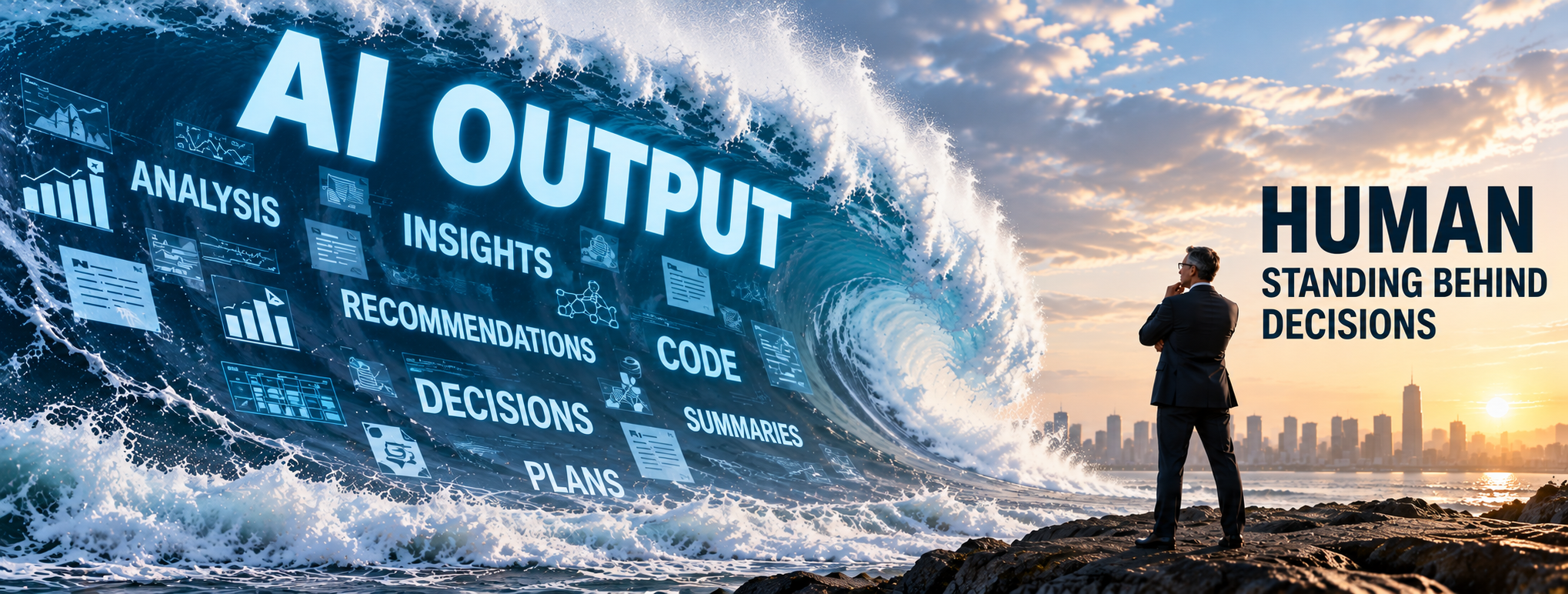
Earlier this year, Sam Altman said:
“You still do need a person to stand behind decisions and kind of exercise human judgment.”
Sure, but how exactly does a human stand behind a decision increasingly reasoned through by AI?
Ironically, we’re increasingly putting the human literally behind the AI.
AI receives the context. AI reasons. AI chooses tools. AI produces the analysis. AI recommends the decision. Then the human gets:
Approve?
We quickly scan the output—or don’t—and click yes. Sometimes we’re just exhausted and turn on auto-approve. That’s technically a human standing behind the decision. But is that meaningful human judgment?
What does it mean to stand behind a decision?
For me to genuinely stand behind a consequential decision, I need confidence in what information was used, what assumptions were made, how the conclusion was reached, and where uncertainty exists. I also need the ability to change the reasoning—not merely approve or reject the result.
Suppose AI recommends:
“Cut these 14 wholesalers because their margins are below 12%.”
The sales executive responds:
“Keep these six. Their territories were temporarily disrupted by hurricanes.”
The human hasn’t simply approved or rejected the AI output. She has changed the reasoning. That’s a decision she can meaningfully stand behind.
Humans need to participate in the reasoning
If humans are expected to stand behind AI-assisted decisions, AI reasoning needs to be understandable, structured into steps, editable by humans, and able to incorporate human judgment. It should also be reusable, so the next decision can build on what humans and AI already learned together.
The reasoning itself can become the collaboration surface between humans and AI.
Sam Altman is right: humans still need to stand behind consequential decisions. But standing behind AI shouldn’t mean standing behind AI—watching it reason and approving whatever comes out.
Tomorrow I’ll share something we’ve been working on with others around exactly this problem: making reasoning between humans, AI models, and software structured, interoperable, and reusable.