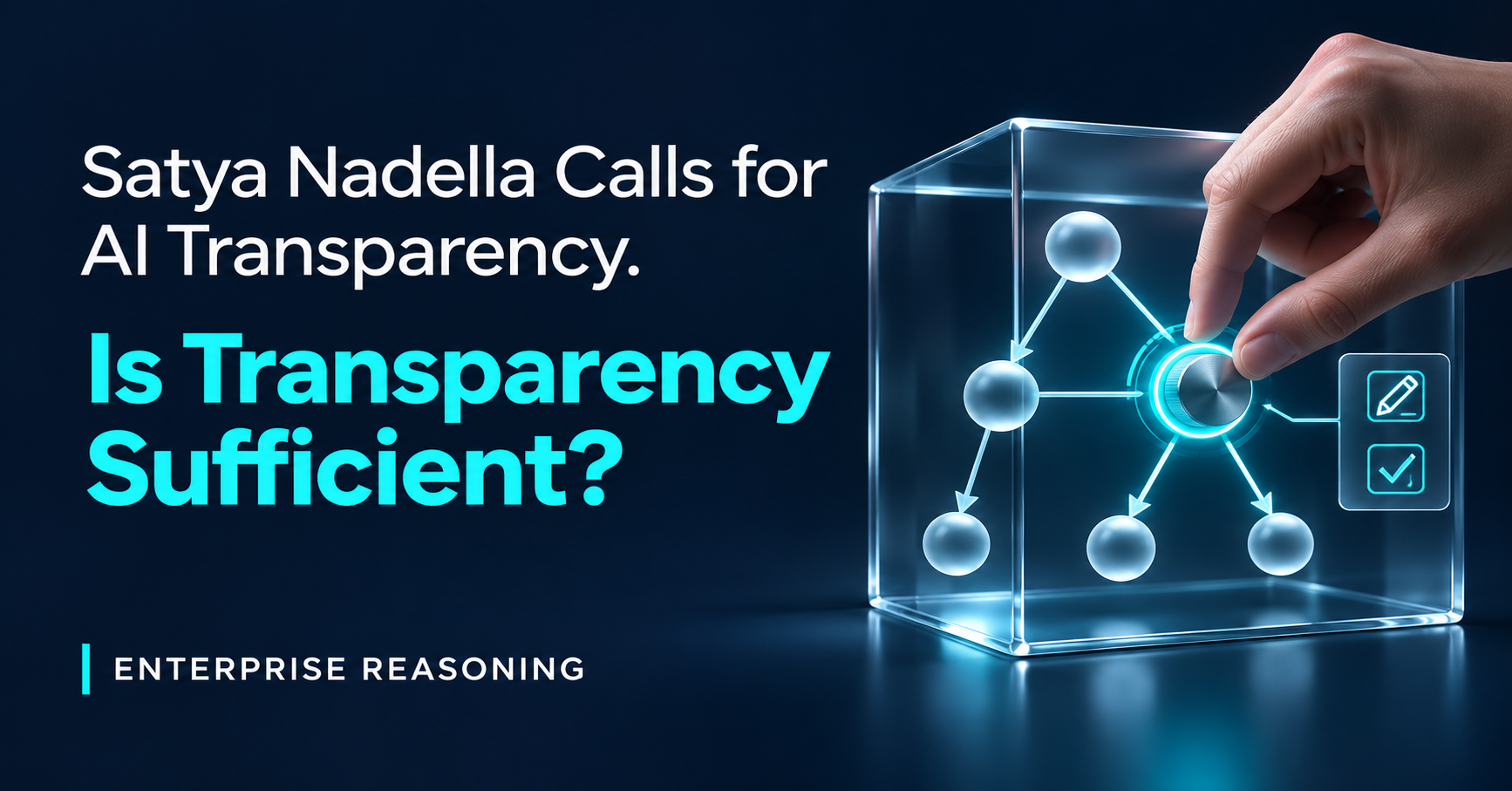
“And what the model tells us about itself is not independent evidence. These nested black boxes are simply unacceptable.”
Satya Nadella made that point in his November 17 Ignite keynote, announcing Microsoft’s AI Transparency Initiative. Source
Two days later, Anthropic began trading publicly. AI’s commercial ambitions and the challenge of trusting it shared the spotlight. Source
For enterprises putting AI to work, Nadella’s statement raises a practical question: what should transparency enable us to do?
Reasoning traces offer a starting point. They let us read the steps a model presents alongside its answer.
But those steps are not necessarily a faithful account of how it reached that answer—a limitation documented by Anthropic’s own researchers. Source
Even a faithful explanation leaves work to do. If an expert spots a flawed assumption, can they correct it, test the change, and preserve the improvement?
Transparency has to be actionable, not just visible.
Consider three examples.
Databases. AI calculates customer profitability using information from several databases.
A finance expert sees that the calculation excludes customer credits. They need to correct the business logic, validate the results, and make the approved analysis reusable.
LangGrant supports this approach: experts review, refine, and approve cross-database reasoning, then save it for repeated execution.
Site reliability engineering. An AI agent sees rising latency and recommends adding capacity.
An engineer suspects connection-pool exhaustion following a deployment. They need to inspect the telemetry, challenge the diagnosis, and test the alternative before approving remediation.
The useful result is a tested operational procedure with supporting evidence that the next incident team can build on.
AI software development. An AI coding agent generates a change that assumes a database migration has already run.
The code looks reasonable. The target database tells a different story.
Developers need to inspect those assumptions against the actual schema and migration state, correct the mismatch, and run compatibility tests before release.
Across these examples, the requirement is the same: connect reasoning to evidence and give people a way to improve it.
That means capturing sources, assumptions, constraints, validation results, and human revisions in a form that tools and teams can use.
Enterprise Reasoning proposes a common, vendor-neutral representation to support that work.
The aim is to make the basis for enterprise decisions reviewable, editable, testable, and reusable.
Microsoft’s transparency initiative opens an important conversation.
The enterprise test is what happens after someone sees a problem.
Can they change the reasoning—and verify that the change works?